



Medically reviewed by Thomas Freeman, MD | Reviewed August 2026
The moment I tell someone they need a rotator cuff repair, a fair number of them reach for their phone and open their calendar. They are looking for cherry harvest, a hunting trip, the start of ski season, a daughter’s wedding. I understand the instinct, and I would rather have that conversation early than have someone discover in week three that rotator cuff surgery recovery does not fit the window they budgeted for it. Recovery after a rotator cuff repair is measured in months, and the first several weeks are spent protecting a repair that has not yet healed to bone.
Key Takeaways
- Rotator cuff surgery recovery progresses in stages, beginning with protection of the repaired tendon before motion and strength are addressed.
- A sling is typically part of early recovery, and its duration depends on the tear and the repair.
- Tendon-to-bone healing sets the pace, which is why rushing the early phase tends to backfire.
- Recovery timelines vary considerably with tear size, tendon quality, and the physical demands you are returning to.
Why the Recovery Takes So Long
During a rotator cuff repair, the torn tendon is reattached to the upper arm bone. The stitches and anchors hold the tendon in position, but they do not create healing. Biology does that, and biology sets its own schedule.
The tendon has to grow a new attachment into bone. Until that interface has some strength, the repair depends entirely on the hardware holding it. Load the arm too early and the tension goes through the repair rather than through healed tissue.
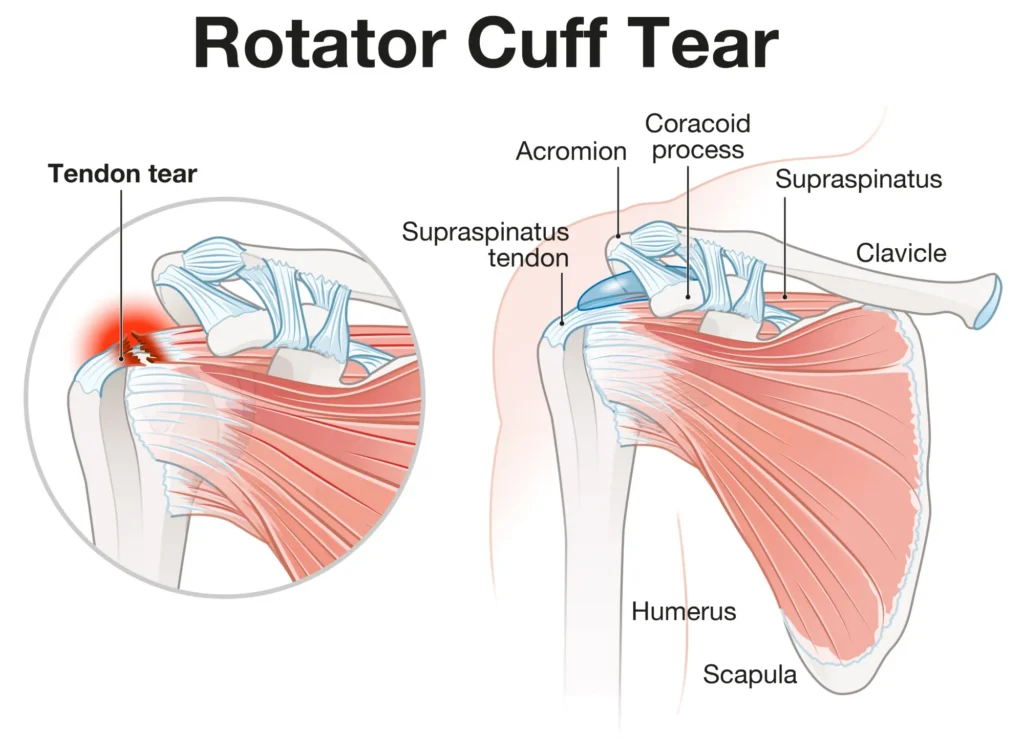
Pain improving is not the same as the repair being strong. Those two things run on completely different timelines, and the gap between them is where most complications come from.
The Phases of Rotator Cuff Surgery Recovery
Rehabilitation generally progresses in stages.
Protection: The earliest phase focuses on keeping the repair safe. Most patients wear a sling, and therapy during this window usually means someone else moves the arm rather than the patient moving it under their own power. The goal is preventing stiffness without stressing the repair.
Motion: Once the repair has had time to begin healing, patients start moving the shoulder actively. Range of motion comes back before strength does. Many people feel encouraged here, since the arm starts cooperating again with daily tasks.
Strength: Resistance work comes last. This phase runs the longest, and it’s an important one for functional gains.
Return to demand: Getting back to physical work, overhead labor, or sport happens after strength has been rebuilt and tested, not on a fixed date.
The transitions between these phases depend on the tear and the repair rather than on a universal protocol. A small tear with healthy tendon tissue and a massive tear with significant retraction do not follow the same schedule, and I set the timeline for each patient after surgery based on what I found and what I repaired.
What Changes Your Individual Timeline
Several things move the schedule in one direction or the other. Tear size and tendon quality matter most. A larger tear with poor tissue needs a longer protected phase, since the repair has less to work with. Fatty infiltration of the muscle, which I evaluate on the preoperative MRI, is another meaningful factor. Your job and your sport matter for the back end. Someone returning to desk work reaches that milestone well before someone returning to overhead construction or hauling gear at a marina.
Smoking, diabetes, and general health also affect tendon healing, and we’ll discuss these in advance of the procedure.
What I See in My Patients
In Traverse City, I see cherry orchard crews who have spent decades reaching overhead, marina and dock workers who load their shoulders every summer, and retirees who consider hauling a kayak onto a roof rack a reasonable Tuesday activity. The specific challenge here is seasonal. Someone in the orchards does not want to be in a sling during harvest, and a ski patroller does not want to be in one in January. We can plan surgery timing around that whenever the tear allows for it.
Where I see recovery go sideways is almost never in the operating room. It is in week five, when the shoulder feels dramatically better, but it’s not quite healed up yet. I’ve seen many patients push too hard, too soon. I would rather a patient call and ask me about it than have them make a poor judgment call on their own.
My Approach to Recovery Planning
I tell patients before surgery, not after, what their recovery is likely to look like. Someone should have a realistic picture of the sling, the therapy schedule, and the return-to-work timeline before they consent to an operation, because that information sometimes changes what they decide.
I do not apply a single protocol to every repair. What I find during arthroscopy shapes the plan I hand to the therapist. Tear size, how much the tendon had retracted, tissue quality, and the security of the fixation all factor into how quickly I let someone progress.
Physical therapy is not optional in my practice, and I say so directly. A well-executed repair with poor rehabilitation produces a stiff, weak shoulder. I would rather see someone in therapy consistently for months than see them back in my office at a year wondering why the shoulder never came around.
For patients whose tears are not repairable, or where the tissue quality makes a repair unlikely to hold, recovery looks different entirely. Those conversations sometimes move toward reverse shoulder replacement, which has its own distinct timeline.
Managing the First Few Weeks
The early weeks are more about logistics than medicine, and thinking them through in advance helps considerably.
Sleeping is the complaint I hear most. Many patients sleep better propped up in a recliner or with pillows under the operative arm than flat in bed, at least at first. Plan for it before surgery rather than improvising at 2 a.m.
Getting dressed, driving, and showering all need workarounds while the sling is on. Arrange help for the first stretch, particularly if the surgery is on your dominant side.
Pain management typically involves a combination of medications, and often a nerve block placed before surgery that covers the first day or two. Pain generally trends downward week over week.
Summary
Rotator cuff surgery recovery runs in phases: protecting the repair, restoring motion, rebuilding strength, and then returning to real demand. The sling and the early restrictions exist because tendon needs time to heal into bone, and that healing does not accelerate to match how good the shoulder feels. Tear size, tissue quality, and the physical demands you are returning to all shift the individual timeline.
Before you schedule a repair, sit down and map out the next six months honestly. Write down your work demands, your travel, anything seasonal, and who can help you at home for the first few weeks. Bring that list to your preoperative visit. Request an appointment or call (231) 935-0900 and we can work through it together.
Frequently Asked Questions
How long will I be in a sling after rotator cuff surgery?
Most patients are in a sling somewhere in the range of four to six weeks, though I set the exact timeline after surgery based on what I repaired. Recovery varies between patients, and no specific timeline can be guaranteed.
Is physical therapy really necessary?
Yes. Motion and strength do not return on their own after a repair, and skipping or delaying therapy tends to produce stiffness that is harder to treat than the original problem.
What happens if I use the arm too early?
Loading a repair before the tendon has healed to bone can compromise the repair. If you are unsure whether an activity is safe, call the office rather than deciding on your own.
Does the pain go away right after surgery?
No. Expect discomfort in the early days, often managed with a nerve block and medication, followed by steady improvement over the following weeks.