

Total Shoulder Replacement
Our Services

Please call us at
(231) 935-0900
for an appointment
Shoulder arthritis and other forms of joint damage can lead to pain, stiffness, weakness, and difficulty moving the arm. Symptoms may affect sleep, work, household tasks, and recreational activities. When nonsurgical treatments no longer provide an acceptable level of symptom management, Total Shoulder Replacement may be considered.
Dr. Thomas Freeman is a board-certified orthopedic surgeon with fellowship training in sports medicine and shoulder surgery. He evaluates patients to determine whether Total Shoulder Replacement or another treatment option may be appropriate based on the diagnosis, condition of the shoulder, overall health, and individual goals.
Dr. Freeman sees patients from Traverse City, Northern Michigan, and surrounding areas throughout the Great Lakes region.
What Is Total Shoulder Replacement?
Total Shoulder Replacement is a surgical procedure used to replace damaged surfaces within the shoulder joint.
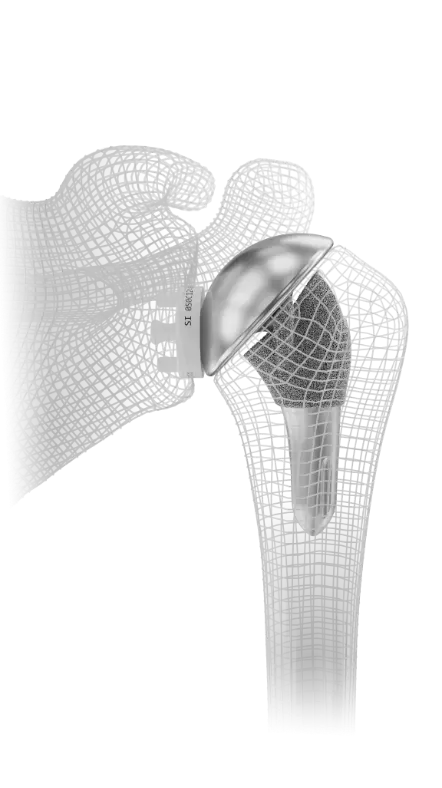
The shoulder is a ball-and-socket joint. The ball is formed by the upper end of the humerus, while the socket is part of the shoulder blade. During Total Shoulder Replacement, the damaged ball is replaced with a metal component, and the socket is resurfaced with a plastic component.
The components are positioned to follow the shoulder’s natural anatomy. For this reason, Total Shoulder Replacement is generally considered when the rotator cuff is intact and able to support the reconstructed joint.
The purpose of the procedure is to address damaged joint surfaces that may be contributing to pain and limited motion. Individual experiences and results vary.
Understanding Shoulder Anatomy
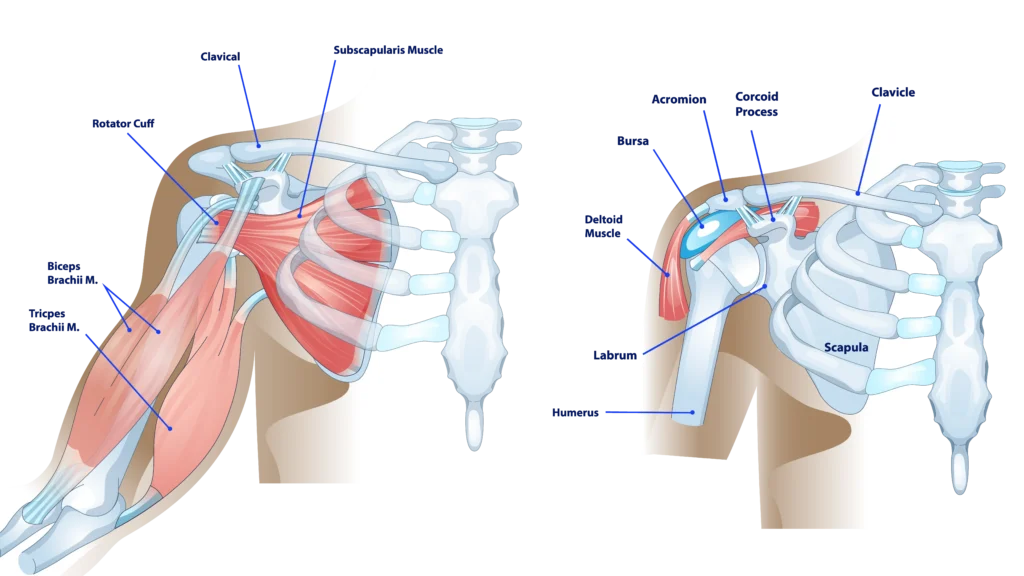
The shoulder joint is formed by three bones:
- The humerus, or upper arm bone
- The scapula, or shoulder blade
- The clavicle, or collarbone
The rounded head of the humerus rests against a shallow socket called the glenoid. Unlike the hip socket, the glenoid does not surround a large portion of the ball. This shallow structure gives the shoulder a wide range of motion but provides limited stability through bone alone.
The shoulder depends on several soft tissues for support. These include:
- The rotator cuff muscles and tendons
- The joint capsule
- The labrum
- Ligaments surrounding the joint
- Muscles that control the shoulder blade
The rotator cuff helps keep the humeral head centered against the glenoid as the arm moves. Because Total Shoulder Replacement follows the shoulder’s natural ball-and-socket arrangement, the condition of the rotator cuff is an important part of the evaluation.
What Is Shoulder Arthritis?
The ends of the bones within a healthy shoulder are covered by smooth cartilage. This cartilage allows the joint surfaces to move against one another with limited friction.
Arthritis occurs when this cartilage becomes damaged or worn. As cartilage loss progresses, the space between the humeral head and glenoid may narrow. The exposed bone can also change shape and develop areas of increased density or bone spurs.
Possible symptoms of shoulder arthritis include:
- Pain with shoulder movement
- Pain at rest
- Night pain
- Stiffness
- Grinding, catching, or clicking
- Reduced shoulder motion
- Difficulty reaching overhead or behind the back
- Difficulty lifting or carrying objects
The presence of arthritis on an X-ray does not automatically mean that surgery is needed. Treatment decisions also consider the patient’s symptoms, physical examination, activity needs, and response to nonsurgical care.
Conditions That May Lead to Total Shoulder Replacement
Total Shoulder Replacement may be considered for several conditions that damage the shoulder joint. The type of replacement depends on the condition of the rotator cuff, bones, and surrounding tissues.
Osteoarthritis
Osteoarthritis is a degenerative joint condition that affects cartilage. Cartilage may become thinner, softer, or less smooth over time. As the cartilage surface changes, areas of the underlying bone may become exposed.
Shoulder osteoarthritis can cause pain, stiffness, grinding, and reduced motion. Night pain is also common among patients who seek an orthopedic evaluation.
Initial treatment may include activity modification, physical therapy, medication, or a corticosteroid injection. Total Shoulder Replacement may be discussed when symptoms continue despite nonsurgical treatment and the rotator cuff remains functional.
Inflammatory Arthritis
Inflammatory conditions, including rheumatoid arthritis, can affect the lining and cartilage of the shoulder joint. Continued inflammation may damage the joint surfaces and contribute to pain, stiffness, and loss of motion.
Treatment often involves coordination with the medical professional managing the underlying inflammatory condition. Total Shoulder Replacement may be considered when joint damage and symptoms continue despite nonsurgical treatment.
The condition of the rotator cuff and bone helps determine whether Total Shoulder Replacement or Reverse Shoulder Replacement may be considered.
Avascular Necrosis
Avascular necrosis occurs when the blood supply to part of a bone is reduced or interrupted. When this affects the humeral head, the weakened bone may change shape or collapse.
Possible causes or risk factors include:
- A previous shoulder injury
- Long-term or high-dose corticosteroid use
- Heavy alcohol use
- Certain medical conditions
- Previous fracture
- No identifiable cause
Early stages may be treated without joint replacement. If the humeral head has collapsed or the joint surface has been damaged, shoulder replacement may be discussed. The recommended procedure depends on the extent of damage and the condition of the socket and rotator cuff.
Post-Traumatic Arthritis
Post-traumatic arthritis can develop after a shoulder fracture, dislocation, or other significant injury. Damage to the cartilage or a change in joint alignment may contribute to arthritis over time.
Symptoms may begin months or years after the original injury. Previous surgery, retained hardware, bone loss, and changes in the rotator cuff may affect treatment planning.
Certain Proximal Humerus Fractures
A proximal humerus fracture affects the upper portion of the arm bone near the shoulder joint. Some fractures remain in an acceptable position and may be treated with a sling and rehabilitation. Other fractures may require surgery.
For certain complex fractures, shoulder replacement may be considered if the joint surface is significantly damaged or the bone cannot be reconstructed reliably. Reverse Shoulder Replacement is commonly considered for some complex fractures, particularly when the rotator cuff attachments or bone fragments are affected.
The treatment decision depends on the fracture pattern, bone quality, age, activity needs, rotator cuff, and overall health.
When May Total Shoulder Replacement Be Considered?
Total Shoulder Replacement is not typically the first treatment for shoulder arthritis. It may be discussed when symptoms continue despite appropriate nonsurgical care.
Factors considered during the evaluation may include:
- The cause and extent of joint damage
- The severity and frequency of symptoms
- Loss of shoulder motion
- Difficulty with everyday activities
- Night pain or difficulty sleeping
- Response to physical therapy, medication, or injections
- Condition of the rotator cuff
- Bone quality
- Overall health
- Previous shoulder procedures
- Personal goals and expectations
No single symptom or imaging result determines whether someone is a candidate. The decision is based on the full clinical evaluation.
Total Shoulder Replacement vs Reverse Shoulder Replacement
Total Shoulder Replacement and Reverse Shoulder Replacement both replace damaged portions of the shoulder joint, but the implants are arranged differently.
Total Shoulder Replacement
During Total Shoulder Replacement, the joint is reconstructed according to its natural anatomy. A ball component replaces the humeral head, and a socket component is placed on the glenoid side.
This option generally depends on a functional rotator cuff to help center and move the joint.
Reverse Shoulder Replacement
During Reverse Shoulder Replacement, the position of the ball and socket is switched. A ball component is attached to the shoulder blade, and a socket-shaped component is placed on the upper arm side.
This design allows the deltoid muscle to contribute more to lifting the arm. Reverse Shoulder Replacement may be considered when the rotator cuff is severely damaged or for certain fractures, revision procedures, or other shoulder conditions.
The recommended procedure depends on the diagnosis, rotator cuff, bone quality, shoulder anatomy, and previous treatment.
Preparing for Total Shoulder Replacement
Before surgery, patients generally complete a medical evaluation and receive instructions for preparation. This process may include:
- Reviewing medications and supplements
- Completing blood work or other testing
- Discussing medical conditions
- Planning for transportation after surgery
- Preparing the home for early recovery
- Arranging assistance with certain daily tasks
- Reviewing postoperative restrictions
- Discussing physical therapy
Certain medications may need to be adjusted before surgery. Patients should follow the instructions provided by their surgical and medical teams rather than stopping medication independently.
What Happens During Total Shoulder Replacement?
The exact surgical plan varies according to the patient’s anatomy and joint damage.
In general, the surgeon reaches the shoulder joint through an incision near the front of the shoulder. Depending on the surgical approach, the subscapularis tendon at the front of the rotator cuff may be released to access the joint. If released, it is repaired before the procedure is completed.
The damaged humeral head is removed and replaced with a metal component. The damaged surface of the glenoid is prepared and resurfaced with a plastic component. The components are positioned to recreate the shoulder’s natural joint structure.
The incision is then closed, and the arm is placed in a sling. Procedure details can differ based on implant fixation, bone quality, surgical technique, and other patient-specific factors.
Risks of Total Shoulder Replacement
All surgical procedures involve risk. Possible risks associated with Total Shoulder Replacement include:
- Infection
- Bleeding
- Blood clots
- Nerve or blood vessel injury
- Stiffness
- Instability or dislocation
- Fracture
- Rotator cuff or subscapularis tendon problems
- Implant loosening or wear
- A difference between expected and actual function
- Continued or recurring pain
- Need for additional surgery
- Medical or anesthesia-related complications
This list does not include every possible complication. Dr. Freeman discusses potential risks and considerations based on the patient’s health and shoulder condition.
Recovery After Total Shoulder Replacement
Recovery after Total Shoulder Replacement occurs in stages. The timeline depends on the surgical approach, condition of the soft tissues, bone quality, overall health, and individual healing.
Early Recovery
A sling is commonly used to protect the shoulder during the early healing period. Patients receive instructions regarding wound care, medication, sleeping positions, bathing, and safe arm use.
Some everyday activities may require assistance at first. Lifting, pushing, pulling, and reaching may be restricted.
Protecting the Subscapularis
The subscapularis is a tendon at the front of the shoulder. Depending on the surgical approach, it may be released during surgery and repaired afterward.
Restrictions may be used to protect this tendon as it heals. Patients should follow instructions regarding external rotation, active movement, lifting, and sling use.
Physical Therapy
Rehabilitation generally progresses through several phases. Early exercises may focus on protected motion. Later phases may introduce active movement and strengthening.
The timing of each phase depends on the procedure and the patient’s progress. Advancing exercises too quickly may place stress on healing tissues.
Returning to Activities
The timing for driving, working, lifting, golfing, sports, and other activities varies. Some activities may be resumed within the first several months, while others may require additional time or may not be recommended.
Clearance is based on healing, strength, motion, coordination, and the demands of the activity. Patients should not return to an activity based only on a general timeline.
Total Shoulder Replacement Based on Your Shoulder
Total Shoulder Replacement may be an option for certain patients with shoulder arthritis or other joint damage and a functioning rotator cuff. It is not the appropriate procedure for every patient with shoulder pain.
Dr. Thomas Freeman evaluates the joint surfaces, rotator cuff, bone, symptoms, medical history, and previous treatments before making a recommendation. Patients are encouraged to ask questions and consider the potential risks, limitations, recovery requirements, and available alternatives.