
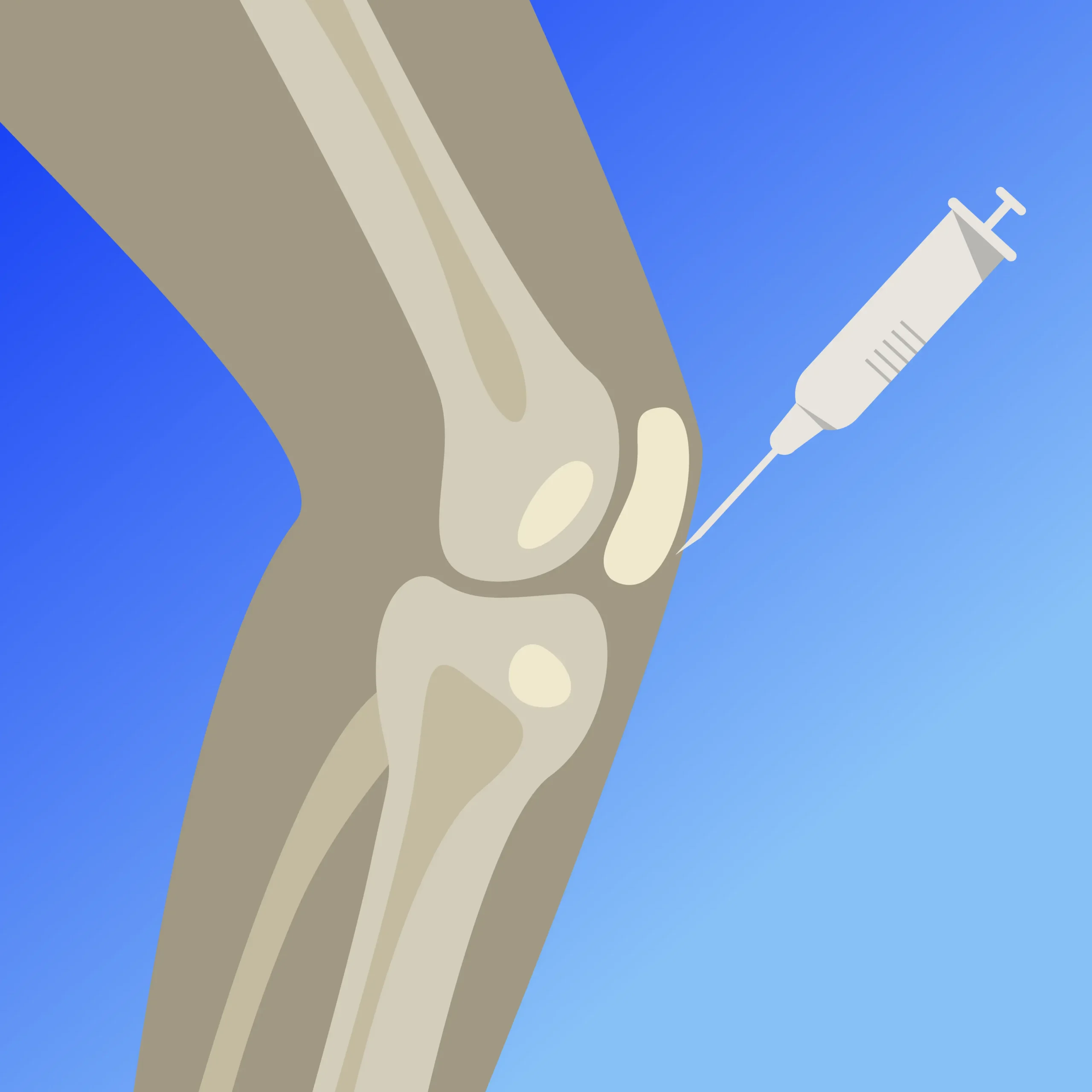
PRP FOR THE KNEE
Our Services
Please call us at
(231) 935-0900
for an appointment
Knee pain may develop from arthritis, tendon changes, cartilage damage, or an injury. Treatment depends on which structure is involved, the extent of the condition, and how symptoms affect activity.
Platelet-rich plasma, or PRP, may be considered for selected causes of knee pain. Research has most strongly examined its use for mild to moderate knee osteoarthritis. PRP has also been studied for certain knee tendon and soft tissue conditions, although the supporting evidence varies by diagnosis.
Dr. Thomas Freeman evaluates the knee before recommending an injection. He considers the diagnosis, imaging findings, previous treatment, medical history, activity needs, and available clinical evidence.
Dr. Freeman sees patients in Traverse City, Northern Michigan, and surrounding areas throughout the Great Lakes region.
Understanding PRP for the Knee
PRP is prepared from a sample of the patient’s blood. The sample is processed to concentrate the platelet-containing portion, which is then injected into the selected treatment area.
PRP is not a mechanical repair. It cannot reconstruct a torn ACL, reconnect a complete tendon tear, stabilize an unstable knee, or repair every meniscus injury. It also should not be described as a treatment that reliably regrows lost cartilage.
PRP may be one part of a broader treatment plan that includes physical therapy, activity modification, bracing, medication, or other forms of care.
Knee Osteoarthritis & PRP
Knee osteoarthritis develops when the cartilage covering the joint surfaces becomes damaged or worn. It may affect the inside, outside, or kneecap portion of the knee.
Symptoms may include:
- Pain during or after activity
- Stiffness
- Swelling
- Grinding or catching
- Reduced knee motion
- Difficulty with stairs
- Pain after prolonged sitting or standing
PRP may be considered for selected patients with mild to moderate knee osteoarthritis. Individual responses vary, and some patients may not experience a meaningful change.
The presence of arthritis on an X-ray does not automatically determine whether PRP is appropriate. Dr. Freeman also considers the location and stage of arthritis, symptoms, knee alignment, motion, activity needs, and previous treatment.
PRP cannot restore the knee to its original condition or replace cartilage that has been lost. It may also be less appropriate when joint damage is advanced or another condition is the primary source of pain.
PRP for Patellar Tendinopathy
The patellar tendon connects the kneecap to the tibia. Patellar tendinopathy, sometimes called jumper’s knee, may develop from repeated jumping, running, or other activities that load the tendon.
Pain is commonly felt near the lower portion of the kneecap. Symptoms may increase with:
- Jumping
- Running
- Squatting
- Stairs
- Rapid changes in direction
- Prolonged activity
Treatment usually begins with changes to activity and a structured rehabilitation program. PRP may be discussed when symptoms continue despite an appropriate period of nonsurgical care.
PRP cannot reconnect a completely torn patellar tendon. Sudden pain, weakness, swelling, or an inability to straighten the knee requires prompt evaluation.
PRP for Quadriceps Tendinopathy
The quadriceps tendon connects the muscles at the front of the thigh to the kneecap. It helps the leg straighten and supports the knee during walking, stairs, running, and jumping.
Quadriceps tendinopathy may cause pain above the kneecap, especially during squatting, jumping, or resisted knee extension.
Physical therapy and activity changes are commonly considered before an injection. PRP may be discussed for selected cases that continue despite nonsurgical treatment.
A complete quadriceps tendon tear is different from tendinopathy. PRP cannot reconnect a completely torn tendon, and surgical repair may be considered.
PRP for Cartilage-Related Knee Pain
Cartilage damage can occur from arthritis, injury, joint alignment, patellar instability, or repeated stress.
PRP may be discussed for selected cartilage-related symptoms, but it cannot reliably restore damaged cartilage. Its potential role depends on the location and extent of the damage.
Chondromalacia Patella
Chondromalacia patella involves changes in the cartilage on the back of the kneecap. It may cause pain at the front of the knee during stairs, squatting, running, or prolonged sitting.
Treatment often focuses on strength, flexibility, activity changes, and movement patterns. PRP has been studied for cartilage-related knee symptoms, but its role in chondromalacia has not been established for every patient.
When May Knee PRP Be Considered?
PRP may be discussed when a patient has a confirmed knee condition for which the treatment has been studied.
Factors Dr. Freeman may consider include:
- The source of knee pain
- Stage and location of arthritis
- Condition of the tendons
- Knee stability
- Duration of symptoms
- Previous treatment
- Medical history
- Work or sport demands
- Patient goals
- Available clinical evidence
Two people with similar knee pain may have different diagnoses and may not be candidates for the same treatment.
The PRP Procedure
A blood sample is drawn and processed to prepare the platelet-containing solution. Dr. Freeman then injects the PRP into the knee joint or selected tendon area.
Ultrasound guidance may be used when appropriate to help identify the treatment area and guide needle placement.
Patients may experience pressure or discomfort during the injection. Soreness, stiffness, or swelling may also occur afterward.
The number of injections varies by diagnosis and treatment plan. A series of three injections should not be assumed for every patient.
Recovery After Knee PRP
Recovery recommendations depend on whether PRP is placed within the knee joint or around a tendon.
Patients may be asked to temporarily limit:
- Running
- Jumping
- Squatting
- Heavy lower-body exercise
- Repetitive kneeling
- Physically demanding work
- Competitive sports
Walking and light daily activity may be permitted earlier, depending on symptoms and the treatment area.
Patients may receive instructions regarding medications, ice or heat, bracing, and physical therapy. Medications should not be stopped unless directed by the appropriate medical professional.
There is no standard timeline for a response. If a change occurs, it may develop gradually. Some patients may not experience a meaningful change.
Physical Therapy & Activity Progression
Physical therapy may remain an important part of care before or after a PRP injection.
A knee rehabilitation program may address:
- Knee motion
- Quadriceps and hamstring strength
- Hip and core strength
- Balance
- Movement control
- Walking or running mechanics
- Gradual return to work or sports
An injection does not replace rehabilitation when weakness, limited motion, or movement patterns contribute to symptoms.
Activity is generally advanced according to symptoms, motion, strength, balance, and function. A general recovery timeline should not be used as clearance to resume sports or physically demanding work.
Summary
PRP may be considered for selected patients with mild to moderate knee osteoarthritis, patellar tendinopathy, quadriceps tendinopathy, or certain other knee conditions.
It is not appropriate for every patient and cannot correct every structural knee problem. Dr. Freeman evaluates the knee before discussing PRP or another injection.
Other treatment options may include physical therapy, activity modification, bracing, medication, corticosteroid injection, viscosupplementation, arthroscopic surgery, ligament reconstruction, tendon repair, or fracture treatment.