



Medically reviewed by Thomas Freeman, MD | Reviewed July 2026
Reverse shoulder replacement is one of the more counterintuitive things I explain in clinic, because on paper it does sound like a strange fix. Why swap the ball and socket to opposite sides of the joint? The reason comes down to how the shoulder works when the rotator cuff is no longer functioning. By changing the mechanics of the joint, a reverse shoulder replacement allows the deltoid muscle to take over more of the work and can restore motion that may not be possible with a traditional replacement.
Key Takeaways
- Reverse shoulder replacement places the ball on the glenoid side and the socket on the humeral side, the opposite of normal shoulder anatomy.
- Common candidates include patients with massive rotator cuff tears, cuff tear arthropathy, and certain complex fractures.
- Reverse replacement lets the deltoid muscle drive shoulder motion instead of the rotator cuff.
The Mechanics Behind the Name
A normal shoulder joint has a ball at the top of the humerus fitting into a shallow socket on the scapula called the glenoid. A reverse shoulder implant flips that arrangement: the ball attaches to the glenoid and the socket attaches to the humerus. That single change shifts the center of rotation of the joint and lets the deltoid, a much larger and more durable muscle than any single rotator cuff tendon, do the work of lifting the arm.
This matters because a standard, anatomic shoulder replacement still depends on the rotator cuff to move the joint after surgery. If the cuff is torn beyond repair, an anatomic implant can relieve pain but often can’t restore the ability to lift the arm overhead. Reverse replacement solves that specific problem by design.
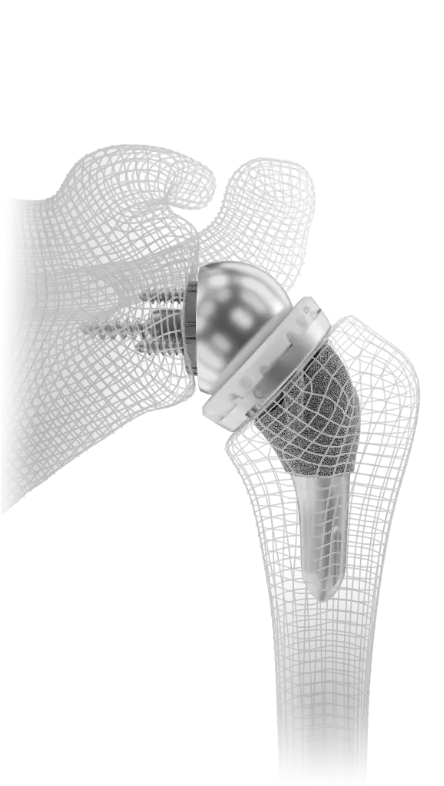
Reverse shoulder replacement has been performed in the United States for decades, so this isn’t an experimental concept. Today it even accounts for a majority of shoulder replacements done nationally.
Who Actually Ends Up Needing This
The largest group I see are patients with massive, irreparable rotator cuff tears. When a tear is large enough, the humeral head can migrate upward and contact the acromion, a bone that isn’t meant to bear that kind of load, and that contact alone can be a significant source of pain and restricted motion.
A second group has cuff tear arthropathy, sometimes shortened to CTA, where a longstanding cuff tear and arthritis develop together. These patients often describe a slow decline: first some weakness, then increasing pain, and eventually an arm that feels almost disconnected from the shoulder when they try to raise it. In severe cases the shoulder can become nearly frozen, a pattern sometimes called pseudo-paralysis.
A third group includes some patients with severe complex fractures of the shoulder, where the bone and surrounding tissue are too damaged for a standard fracture repair or total shoulder replacement to hold up reliably.
How It Compares to a Total Shoulder Replacement
The two procedures aren’t competing options for the same problem. A total shoulder replacement restores the joint to its normal anatomic configuration and works best when the rotator cuff is healthy enough to power it. It’s generally the first choice for straightforward arthritis with an intact cuff.
Reverse replacement is the answer when that cuff can’t do its job anymore, regardless of why. I’ve had patients ask which one is “better,” and the honest answer is that the better implant is the one matched to the anatomy on the MRI, not a general ranking of one technology over another.
What Recovery Actually Looks Like
Recovery follows a familiar arc: a period in a sling, a structured physical therapy program, and a gradual return to daily activities over the following months. Because reverse replacement relies on the deltoid rather than a repaired rotator cuff, therapy protocols are often built around protecting that muscle early on rather than rushing early rotator cuff strengthening the way a repair recovery might.
Who Isn’t a Good Fit
Reverse shoulder replacement isn’t the right call for every damaged shoulder, and I’ll say that directly to patients who come in assuming it’s the newer, better version of a total shoulder replacement. Someone with a healthy rotator cuff and straightforward arthritis is usually better served by an anatomic implant, which tends to allow for a bit more rotational strength and doesn’t place the same long-term demand on the deltoid.
Very active, younger patients with an intact cuff are another group where I may lean away from reverse replacement when there’s a reasonable alternative. Anatomy and activity level both factor into the decision, not just age on its own.
What I See in My Patients
A good number of the reverse shoulder replacements I do are on people who spent decades doing physical work up here, orchard labor, marina and boatyard jobs, home construction, and simply outlasted their rotator cuff. By the time they get to me, a lot of them have adapted so completely that they’ve stopped mentioning things like reaching for a top shelf or lifting a grandchild, because they assumed that ability just wasn’t coming back.
I think that’s the part people underestimate about reverse replacement. It’s not just about pain relief; it’s also about function that patients had quietly written off years earlier. I’ve had patients tell me the thing they missed most wasn’t a sport or a hobby, it was being able to put dishes away on a high shelf without asking someone else to do it.
My Approach to Treatment
I don’t treat reverse shoulder replacement as a fallback option or a last resort. When the anatomy calls for it, I present it as the primary recommendation, because pushing a repair or an anatomic implant onto a shoulder that can’t support it usually just delays a better outcome and adds a second surgery to the timeline.
I plan my reverse shoulder replacements using the InSet® Reverse system with ProVoyance® 3D planning, which lets me size and position the implant against a model of the patient’s own bone before surgery. The InSet® Reverse system features a dual-lateralized design, which aims to help restore a more natural center of rotation and improve the biomechanics of the reconstructed shoulder. I also favor bone-preserving implant options where the anatomy allows it.
Summary
If overhead motion has quietly disappeared from your daily routine, or a previous rotator cuff repair hasn’t held up the way you hoped, that’s worth a direct conversation rather than continued adaptation. Bring your prior imaging and any operative reports if you’ve had shoulder surgery before. Schedule a visit and we’ll chat about whether reverse shoulder replacement fits your anatomy, or whether there’s a different path still worth trying first.
Frequently Asked Questions
Is reverse shoulder replacement only for older patients?
Age is a factor in the decision, but the primary driver is the condition of the rotator cuff and the specific problem being treated. Younger patients with massive irreparable tears or certain fractures can also be candidates.
Will I have full range of motion after reverse shoulder replacement?
Many patients regain substantial overhead function and see significant pain relief, though the amount of motion depends on factors like deltoid strength, pre-surgery function, and how closely the rehab program is followed.
What happens if a reverse shoulder replacement eventually needs revision?
Bone-preserving implant design is intended to make a future revision more straightforward if one is ever needed, which is one of the factors I weigh when planning the initial surgery.
How is reverse shoulder replacement different from a standard shoulder replacement?
A standard, or anatomic, replacement keeps the ball and socket in their normal positions and depends on a functioning rotator cuff. Reverse replacement switches those positions so the deltoid muscle can power the joint instead.