



Medically reviewed by Thomas Freeman, MD
A knee injury rarely comes with a label already attached. Something twisted, something hurt, and now there is a decision to make about whether this is a few-days problem or an appointment problem. Meniscus tear symptoms follow patterns, and most of the time the difference between a meniscus tear and a torn ligament is detectable before anyone orders an MRI. In this post, I’ll go through what a torn meniscus tends to feel like, which symptoms carry the most weight in my exam room, and how a meniscus injury gets separated from the other things that go wrong in a knee.
Key Takeaways
- Joint-line pain, catching or locking, and pain with twisting or squatting carry the most diagnostic weight.
- Swelling that builds over a day or two points differently than swelling that appears within a few hours.
- A knee that will not fully straighten deserves prompt evaluation rather than a wait-and-see approach.
What the Meniscus Does
Each knee has two menisci. They are wedges of cartilage that sit between the femur and the tibia, one on the inner side and one on the outer. They spread load across the joint, add stability, and keep the rounded end of the femur from grinding on the flat top of the tibia.
They are load-sharing structures, which is why I treat them as worth preserving whenever the tear pattern allows. A meniscus still doing its job is protecting cartilage the knee will need for decades.
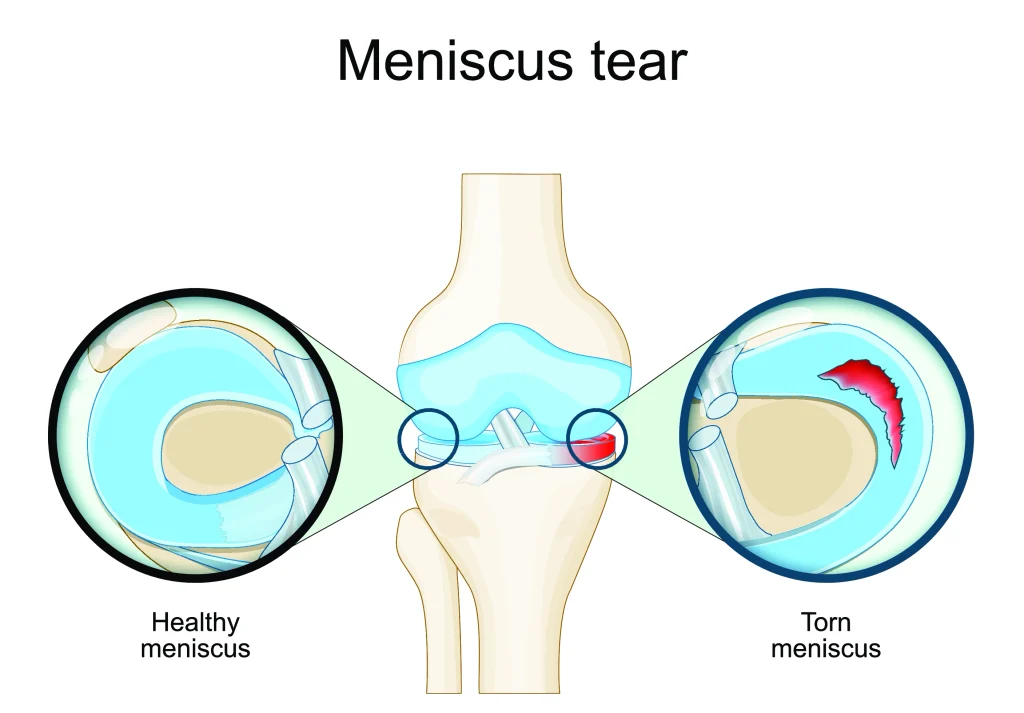
The Meniscus Tear Symptoms That Tell Me the Most
Patients often arrive with a long list of complaints. A few of them matter more than the rest.
Pain along the joint line is the first. This is pain you can locate with one finger, right in the crease where the femur meets the tibia. Diffuse aching across the whole knee is far less specific. Pain a patient can point to precisely is one I pay special attention to.
Catching or locking is the second. A torn flap can get caught between the bones during movement, and the knee responds by hitching, sticking, or briefly refusing to move. Patients describe the knee getting stuck, or something moving inside the joint.
Pain with twisting or squatting is the third. Deep squatting and pivoting compress and rotate the meniscus at the same time, and a torn one tends to object. Many patients tell me they can walk a mile without trouble but cannot get down to load the dishwasher.
Stiffness and difficulty getting the knee fully bent or straight round out the picture. Both are common with a torn meniscus. Both also show up with plenty of other knee problems, so I weigh them less heavily on their own.
What the Swelling Pattern Tells Me
A knee that swells substantially within a few hours of a twisting injury usually means something bled inside the joint. The ACL is one of the more common causes of that pattern, though certain meniscus tears can bleed too.
A knee that swells gradually is more typical of a meniscus tear. It comes up over a day or two and then lingers. The swelling is joint fluid rather than blood, and it often comes and goes with activity for weeks. Patients describe a knee that puffs up after a long day and settles overnight.
Neither pattern is a diagnosis on its own, but both narrow the field of possibilities.
The Symptom That Needs Attention Quickly
If the knee will not fully straighten, the urgency changes. A large tear can flip a fragment of meniscus into the middle of the joint, where it acts as a physical block. The knee gets stuck short of full extension, and no amount of stretching resolves it. That is a mechanical problem rather than a stiffness problem, and it does not improve with time.
I would rather see that knee early. A locked knee that sits for weeks becomes harder to treat, and the window where the torn tissue is most repairable is not unlimited.
Telling a Meniscus Tear From Everything Else
To tell a meniscus tear from other knee conditions, three comparisons come up constantly.
A torn ACL tends to announce itself with a pop and swelling within a few hours. Later comes a sensation that the knee gives way when turning. Instability is the theme. A meniscus tear is more likely to catch than to buckle.
An MCL injury produces tenderness along the inner side of the knee, usually above the joint line rather than in it. It hurts most when the knee is stressed sideways. The mechanism generally involves a blow to the outside of the leg or a fall with the leg splayed outward.
Knee arthritis produces a more diffuse ache, morning stiffness, and pain that tracks with activity over months rather than starting on a specific day. The overlap here is real. Degenerative meniscus tears and arthritis frequently share a knee, and sorting out which one is generating the symptoms is often the actual clinical question.
Age Changes the Story
A meniscus tear in a twenty-year-old and one in a fifty-five-year-old are different injuries that share a name.
The younger version is usually traumatic. There is a moment: a cut on the soccer field, a twist during a tackle, a landing that went wrong. The tissue was healthy until the force exceeded it, and the tear pattern is often one that can be repaired.
The older version is usually degenerative. The meniscus thins and stiffens over years, and the tear happens during something ordinary. Standing up from a low chair. Getting out of a truck. Patients often tell me nothing happened, which is accurate from their point of view. These tears frequently respond to therapy, activity modification, and time. Surgery is a smaller part of the conversation than most patients assume when they hear the word torn.
What I See in My Patients
Northern Michigan hands me both versions. Fall and winter bring the traumatic tears, frequently alongside a ligament injury, from football, hockey, and the ski hills. Spring and summer bring the degenerative ones, and they arrive with a specific origin story: the first weekend of yard work, the first round of golf, the first day in the garden.
My Approach to Treatment
My first job is deciding whether the meniscus is actually the source of the symptoms. That is not automatic, especially in a knee that also has arthritis. I start with the history and a physical exam that loads and rotates the meniscus deliberately. MRI fills in the tear pattern and location when the picture needs clarifying.
For many tears, particularly degenerative ones without locking, I start non-surgically. Activity modification, physical therapy focused on quadriceps and hip strength, and time resolve a meaningful number of these. I am not in a hurry to operate on a knee likely to settle down on its own.
Surgery moves up the list when the knee locks, when a fragment blocks motion, or when symptoms persist despite honest non-surgical treatment. When I do operate, the decision is between meniscus repair and partial meniscectomy. Repair stitches the torn edges together and asks them to heal, which works best with certain tear patterns, locations, and patients. A partial meniscectomy removes the unstable piece that cannot be repaired. My bias is toward preserving tissue whenever the tear allows it, because every millimeter left in the knee is still doing load-sharing work.
For knees where degenerative change drives symptoms more than the tear does, PRP for the knee sometimes enters the discussion as one part of a broader plan. I am direct about its limits. It is not a mechanical repair, and it will not free a fragment of meniscus caught in the joint.
Summary
Meniscus tear symptoms cluster around joint-line pain you can point to, catching or locking, gradual swelling, and pain with twisting or deep squatting. Rapid swelling within hours points more toward a ligament injury. A knee that will not fully straighten points toward a fragment blocking the joint. Younger patients tend to tear healthy tissue during a specific event, while patients past forty more often tear tissue that has been thinning for years, and those two situations get treated differently.
If your knee is catching, locking, or refusing to straighten, do not give it a month to sort itself out. Before your visit, note which specific movement reproduces the pain, whether that is squatting, pivoting, or straightening. That answer shapes the exam. You can request an appointment online or call the office at (231) 935-0900.
Frequently Asked Questions
Can a meniscus tear heal on its own?
Some can. The outer portion has a blood supply and the capacity to heal, which is also why tears there are the ones most likely to be repairable surgically. The inner portion has little blood supply and generally does not heal on its own, though symptoms from a tear there may still improve with therapy and time.
Can I walk on a torn meniscus?
Most patients can, and that is part of why these injuries get delayed. Walking in a straight line does not stress the meniscus the way twisting, squatting, and pivoting do. The exception is a knee that is locked or will not fully straighten, which needs evaluation rather than more walking.
Does a torn meniscus always need surgery?
No. Many tears, particularly degenerative ones without mechanical symptoms, are managed with activity modification, physical therapy, and time. Surgery moves up the list when the knee locks, when a fragment blocks motion, or when symptoms persist despite non-surgical treatment.
Will an MRI always show a meniscus tear?
Not always. MRI picks up most meniscus tears and shows the pattern and location that determine whether repair is possible, but it can occasionally miss one. It is not a substitute for the exam. Plenty of MRIs show meniscus changes in knees that are not symptomatic from them, so I match the imaging to the history and the physical findings rather than treating the report on its own.