


Medically reviewed by Thomas Freeman, MD | Reviewed August 2026
A shoulder labral tear is easy to miss. The symptoms don’t always point neatly at the labrum, and patients sometimes arrive having been told it’s a strain. During my fellowship in sports medicine and shoulder surgery at the University of Michigan, I spent significant time evaluating and treating labral pathology. I know what findings make me suspicious of a labral tear, what I look for during an examination, and when imaging can help confirm the diagnosis. In this post, I’ll walk through how I identify a shoulder labral tear and the treatment options I consider once we know what’s causing the problem.
Key Takeaways
- The labrum is a ring of cartilage around the shoulder socket that adds depth, stability, and an attachment point for ligaments and the biceps tendon.
- Symptoms may include deep shoulder pain, clicking or catching, and a sense that the shoulder may slip.
- Treatment depends heavily on where the tear sits and what symptoms it causes, since not every labral tear needs surgery.
What the Labrum Does
The shoulder is a ball-and-socket joint, but the socket is unusually shallow. The glenoid, the socket portion of the shoulder blade, is considerably smaller than the humeral head that sits against it. That mismatch is what gives the shoulder its remarkable range of motion.
The labrum is the ring of cartilage around the rim of that socket. It deepens the socket, and it serves as the anchor point for several ligaments and the long head of the biceps tendon.
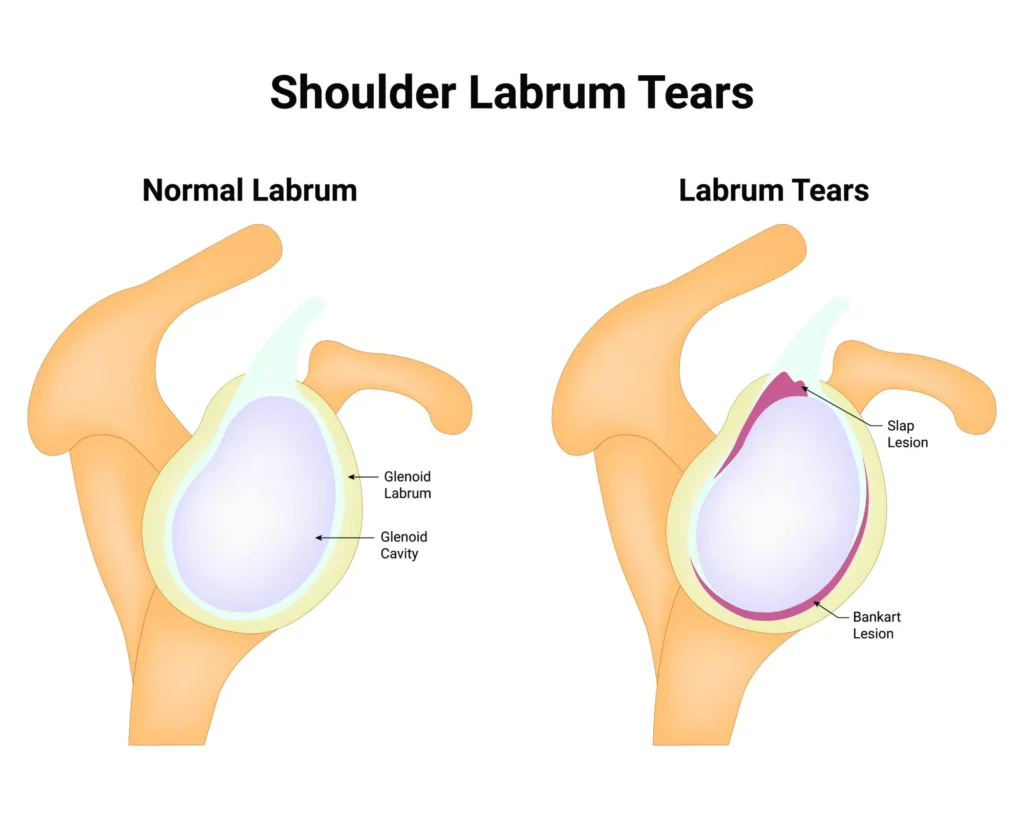
I describe it to patients as the difference between setting a golf ball on a flat table and setting it on a tee. The tee does not grip the ball. It just gives it somewhere to sit. Take the rim away and the shoulder loses a meaningful amount of its passive stability, which is why labral injuries and instability so often travel together.
How Labral Tears Happen
A labral tear may occur during a dislocation, a fall, a pulling injury, or repetitive overhead activity. Labral tissue also changes over time, so not every tear traces back to a single event.
Two patterns account for most of what I see. The first is traumatic. A shoulder dislocates, and the labrum tears as the humeral head comes out of the socket. That version has a clear starting point and the patient can usually name the exact day it happened. A dislocation can also damage ligaments, cartilage, or bone along with the labrum, and that broader picture matters more for planning than the labral tear alone.
The second is gradual, from repetitive overhead loading. Throwers, swimmers, and people whose work keeps their arms above shoulder height accumulate stress on the labrum over years. These patients rarely identify a specific injury.
Recognizing the Symptoms
Labral pain sits deep, inside the joint, and patients frequently struggle to point at it. When someone circles the whole shoulder with a hand rather than tapping one spot, I start thinking about the labrum.
Clicking, catching, or a grinding sensation with certain arm positions suggests tissue moving where it should be fixed. This is different from the clicking many people have painlessly for years. Another symptom is apprehension. Patients describe a feeling that the shoulder might slip out, often in a specific position such as reaching back to throw. Some avoid that position entirely without consciously realizing they have stopped using it. Weakness can occur, though it tends to be less defined than the pattern a rotator cuff tear produces.
How a Labral Tear Gets Diagnosed
Diagnosis begins with a detailed history. Whether the shoulder has ever dislocated, what positions provoke symptoms, and what the patient does repetitively all narrow the field considerably before I touch the shoulder.
The physical examination uses positions that load the labrum and reproduce symptoms, along with tests that assess how much the humeral head translates within the socket.
X-rays come first among imaging, largely to evaluate the bone. In someone with a history of dislocations, I am specifically looking for bone loss on the front of the glenoid, because bone loss changes the surgical conversation substantially. MRI shows the soft tissue. Labral tears can be difficult to see on a standard MRI, so contrast is often used to improve visualization of the labrum and surrounding structures.
What I See in My Patients
Northern Michigan sends me a different labral population than a purely urban practice would. I see young athletes after a first dislocation, often from football, hockey, or a fall on the ice. I see overhead workers whose shoulders have absorbed years of repetitive loading. And I see a category I did not expect before moving here: adults in their thirties and forties who dislocated a shoulder in high school, never had it evaluated properly, and have been quietly losing shoulder function ever since.
A first-time dislocation in a young athlete carries a meaningful risk of recurrence, and the shoulders that dislocate repeatedly tend to accumulate damage each time. Bone loss in particular is progressive and it is far easier to address before it becomes significant. My honest opinion is that a first dislocation in a teenager deserves a real conversation about risk, not just a sling and a follow-up in six weeks.
My Approach to Treatment
Not every labral tear needs surgery. Treatment may involve rehabilitation, activity changes, or arthroscopic surgery, depending on where the tear sits and what symptoms it causes.
For many patients, particularly those without recurrent instability, I start with a structured physical therapy program focused on the rotator cuff and the muscles controlling the shoulder blade. Strengthening the dynamic stabilizers can compensate for a good deal of what a torn labrum no longer provides passively.
When the shoulder keeps dislocating, or when instability persists despite rehabilitation, I discuss shoulder stabilization surgery. Arthroscopic labral repair reattaches the torn labrum to the rim of the socket. Where significant bone loss exists, a repair alone may not be sufficient, and the procedure I recommend changes accordingly. That is a decision I make from imaging rather than from symptoms.
Patients ask me regularly about PRP for the shoulder, and I want to be clear here. PRP may be considered for selected shoulder tendon conditions, but it is not a mechanical repair for torn labral tissue. A tear that needs to be reattached to bone will not be reattached by an injection.
The other factor I weigh heavily is what the patient needs the shoulder to do. A competitive overhead athlete and a patient whose shoulder only bothers them reaching into a cupboard warrant different recommendations, even with similar imaging.
Summary
The labrum deepens a shallow socket and anchors the ligaments and biceps tendon, so a shoulder labral tear tends to produce deep joint pain, mechanical clicking or catching, and a sense of instability rather than the clean weakness of a cuff tear. Diagnosis leans on history, a targeted examination, and imaging, with X-rays evaluating bone loss and MRI, often with contrast, showing the labrum itself. Rehabilitation works for many patients. Arthroscopic repair enters the conversation with recurrent instability or persistent symptoms.
If you have dislocated a shoulder more than once, I advise getting it imaged even if it currently feels stable. Bone loss develops silently with repeat dislocations, and it is far more straightforward to address before it accumulates. When you come in, try to describe the exact arm position that makes the shoulder feel unsafe rather than describing the pain generally. Overhead, behind you, reaching across your body, each points somewhere different in the joint. Schedule an evaluation or call the office at (231) 935-0900.
Frequently Asked Questions
Can a labral tear heal on its own?
Torn labral tissue generally does not reattach itself to the socket. Many patients improve symptomatically with rehabilitation that strengthens the surrounding muscles, even without surgical repair.
What is the difference between a labral tear and a rotator cuff tear?
They involve different structures. The labrum is cartilage around the socket and contributes to stability, while the rotator cuff is a group of tendons that move and center the joint. Labral tears more often produce deep pain, clicking, and instability, and cuff tears more often produce a defined weakness pattern and night pain.
Do I need surgery for a labral tear?
Not necessarily. Treatment depends on the location of the tear, the symptoms it causes, whether the shoulder is unstable, and your activity demands. Many labral tears are managed without surgery.
How is a labral tear diagnosed if MRI can miss it?
Standard MRI can under-detect labral tears, which is why contrast is often used to improve visualization. History and physical examination carry substantial weight in this diagnosis as well.
Is one shoulder dislocation a problem if it went back into place?
It can be. A first dislocation in a younger athlete carries a meaningful recurrence risk and may have damaged the labrum or bone. An evaluation is reasonable even if the shoulder feels normal afterward.